Jal Jeevan Mission Context: The Union Cabinet approved the extension of the Ministry of Jal Shakti’s Jal Jeevan programme to 2028 and provisioned more money to meet its goal of providing a minimum amount of daily potable water to every rural household in the country. The Jal Jeevan Mission (JJM) was introduced in 2019 with the objective of ensuring Functional Household Tap Connections (FHTC) that supply 55 litres of drinking water per person per day to every rural household in India by 2024. The mission promotes planning at the village level and encourages active involvement of local communities in making decisions related to water supply systems. Under the programme, at least 50% of the members in the Village Water and Sanitation Committee (VWSC) / Pani Samiti must be women, ensuring gender participation in water management. About Jal Jeevan Mission The earlier National Rural Drinking Water Programme was reorganized and merged into the Jal Jeevan Mission. Nodal Ministry: The mission is implemented by the Department of Drinking Water and Sanitation under the Ministry of Jal Shakti. It is a Centrally Sponsored Scheme. Funding Pattern (Centre–State Sharing) 90:10: For Himalayan States such as Uttarakhand and Himachal Pradesh, and for North-Eastern States. 100% Central Funding: For Union Territories. 50:50: For all other States in India. Major Achievements of Jal Jeevan Mission (JJM) Since the launch of Jal Jeevan Mission in 2019, more than 12 crore rural households have been provided with piped drinking water connections, compared to 3.23 crore households earlier, according to the Economic Survey 2024–25. States that have reached 100% tap water coverage include Arunachal Pradesh, Goa, Haryana, Himachal Pradesh, Gujarat, Punjab, Telangana, and Mizoram. Union Territories with full coverage are Andaman and Nicobar Islands, Dadra and Nagar Haveli and Daman and Diu, and Puducherry, where every rural household now has…

Operational Guidelines Jal Jeevan Mission (JJM) released by PM Narendra Modi in New Delhi
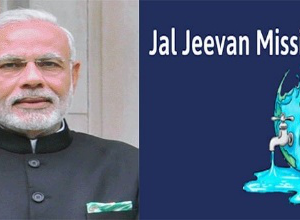
On the occasion of Good Governance Day i.e. on December 25, 2019, Indian Prime Minister, Narendra Modi has released the Operational Guidelines for th implementation of Jal Jeevan Mission (JJM), during an event organized at Vigyan Bhawan, New Delhi. Key Points: Need for JJM: Out of 17.87 Crore Indian rural households, there are 14.6 Crore households who do not have household water tap connection facility. They account 81.67%. Project Financing: On financing front, Centre will provide Rs.2.08 lakh Crore while the fund sharing pattern to be 90:10 for Himalayan and North-Eastern States; 50:50 for other States and 100% for UTs. Institutional arrangement proposed for JJM Implementation: National Jal Jeevan Mission at the Central level State Water and Sanitation Mission (SWSM) at State level District Water and Sanitation Mission (DWSM) at district level Gram Panchayat and/ or its sub-committees i.e. Village Water Sanitation Committee (VWSC)/ Paani Samiti at village Level : Village Water Sanitation Committee (VWSC)/ Paani Samiti at village Level – It has been proposed to imbibe the spirit of 73rd Amendment of Constitution of India which states that Gram Panchayats or its sub-committees play a crucial role in planning, designing, execution, operations and maintenance of the in-village infrastructure. About JJM: Approved on 13.08.2019, the `60 lakh Crore Jal Jeevan Mission (JJM) aims to provide Functional Household Tap Connection (FHTC) i.e. Har Ghar Nal Se Jal (HGNSJ) to every rural household by 2024 with service level at the rate of 55 litres per capita per day (lpcd). The National Rural Drinking Water Programme (NRDWP) subsumed into Jal Jeevan Mission (JJM) by Government.
